
Key Takeaways
- New England’s booming life sciences sector demands a workforce skilled in high-tech manufacturing processes, creating a critical need for STEM programs to integrate industry-relevant training.
- Equipping labs with student-appropriate systems that replicate real-world operations, such as fluid handling, process control, and automation, is essential for preparing students for careers in biomanufacturing and R&D.
- AET Labs supports educators with tailored lab solutions, grant assistance, and hands-on training equipment that align with life sciences workforce needs and funding opportunities.
The life sciences industry is alive and thriving in New England, with core sectors like biopharma and biomanufacturing setting rapid growth benchmarks compared to global trends.
Massachusetts alone has over 62 million square feet of manufacturing and Good Manufacturing Practice (GMP) space, and industry leaders like ABI-LAB and Biogen are expanding their footprint and operations throughout the Northeast.
It’s a rapidly evolving field on the cutting edge of life sciences technology, and technical high schools, community colleges, and universities in New England will be key allies equipping tomorrow’s workforce.
Is your lab prepared to keep pace with the life sciences boom in New England? At AET Labs, we’re helping educational institutions stay ahead of the game with technology and insights that translate directly to life sciences careers.
A Snapshot of Life Sciences Manufacturing Opportunities
The life sciences industry is extremely reliant on advanced technology and Industry 4.0 strategies. While fields like biomechanical engineering will be led by scientists and researchers, manufacturing roles like R&D technologists, automation specialists, and field service engineers will be the beating heart of day-to-day operations.
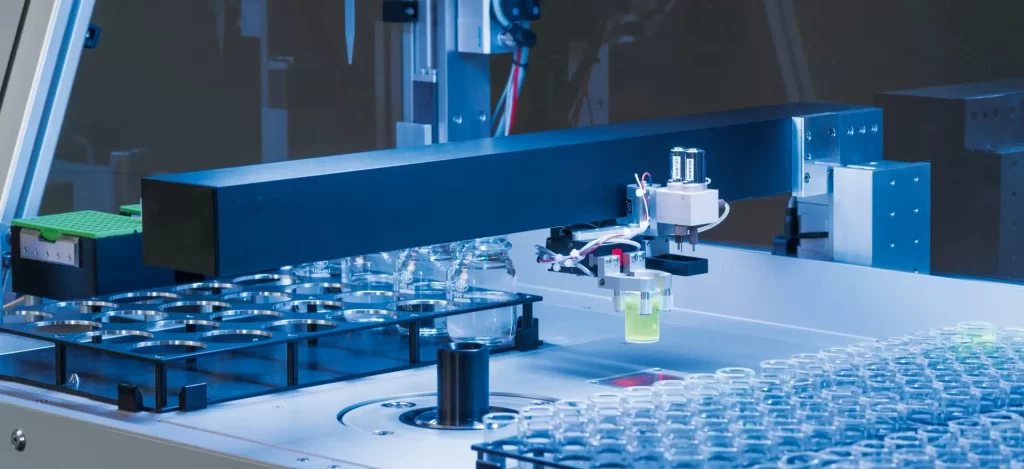
Institutions will need to introduce the industry-relevant skills, equipment, and concepts these workers will use on the job, including areas like:
- Sample handling
- Gas/liquid handling
- Quality control
- Equipment operation
- Process automation
- Maintenance and repair
Modern Life Sciences Industry Equipment
The Mass General Hospital network handles upwards of 13 million laboratory samples a year with around-the-clock operations. Major labs throughout New England rely on automated systems and complex technology to meet demand, and it takes skilled technicians to operate and maintain their critical infrastructure.
Professionals in these roles will encounter systems in areas such as:
- Gas regulation. Precision equipment uses pneumatic valves and digitally controlled mechanisms to dispense common medical gases.
- Liquids automation. This equipment precisely moves and dispenses liquids into a variety of containers.
- Sample kinematics. These systems store, move, and organize samples in sterile lab conditions.
- Storage and transportation. Packaging, palletizing, and transporting sensitive biological material requires specialized processes and technology.
Picking Ideal Training Equipment for Your Lab
Unfortunately, selecting equipment for life sciences manufacturing training can be extremely difficult without proper guidance. Industrial systems can be proprietary, difficult to maintain, too complex for students, and often purpose-built for a narrow range of operations.
At AET Labs, we specialize in equipping our New England partners with training technology that delivers a hands-on experience of the principles and processes learners can expect to encounter in the workplace, in a way that is approachable for students. The following systems are a few of our top recommendations for labs specializing in life sciences roles.
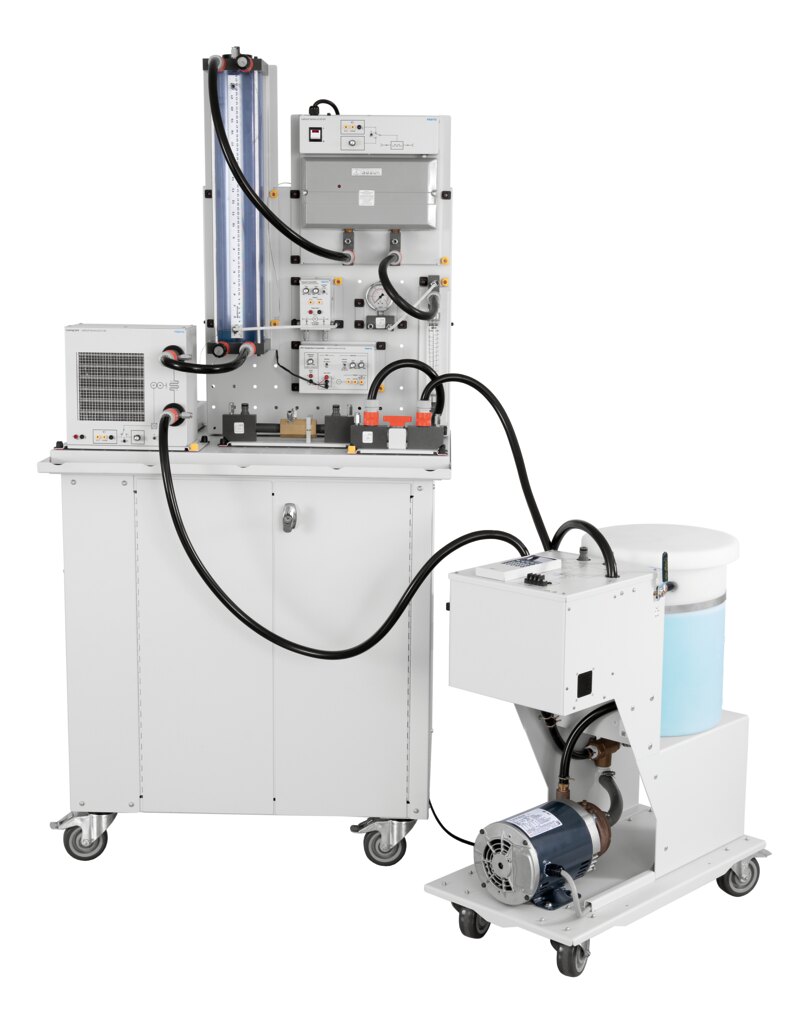
This workstation gives students a hands-on introduction to pressure, flow, and level process control systems. While industrial analogues are often expensive and impractical, this modular system leverages affordable components that mimic lab-grade technology.
This system features:
- Centrifugal pumps operation, curves, cavitation, and NPSH
- PID and cascade process control
- Web-based process control software supporting remote control
- Protected analog input/output

Festo’s MPS PA workstation delivers four process-controlled loops that can be individually operated. Sensors and valve actuators can be used continuously or discontinuously, and actuators can be adjusted for both speed and direction.
Designed as an all-in-one system, it gives learners an experience of how liquids move in automated systems with an emphasis on life sciences applications.

This platform delivers a comprehensive look at the control systems associated with pressure, level, and process control systems. It features two HART differential-pressure transmitters in a two-sided workstation, providing large-scale process loops in real-world, limited-space environments.
This system allows instructors to create realistic training scenarios, such as:
- Loop tuning using trial-and-error, Ziegler-Nichols, and ultimate period
- PID and cascade process control
- Troubleshooting experiences
- High modularity to develop universal skills
Securing Funding for Life Sciences Training Equipment
Massachusetts-based institutions have several grant opportunities available, and AET Labs specializes in connecting our partners with these resources.
The Massachusetts Life Science Center is a major funding organization for secondary and post-secondary programs providing industry-oriented training and certifications in the life sciences. They offer funding for a wide range of investments, including:
- Professional development
- Lab materials
- Technology acquisition
- Renovations
- Furniture and supplies
Of course, navigating the funding process can be challenging, and our specialists can help identify the right opportunity for you and tailor your application to align with their priorities.
Bring Your Life Sciences Lab to Life with AET Labs
New England will continue to be a global leader in life sciences manufacturing and technology. With the right investments, educational institutions can empower their students with the knowledge and hands-on experience to be successful in a wide range of bio and life sciences careers.
Whether you’re looking to update your current lab to align with evolving industry trends or create a program from the ground up, AET Labs provides end-to-end support, from consultation on grants and lab design to acquiring, installing, and maintaining the best training equipment on the market today.
Contact AET Labs for a local partner to connect your New England program with industry skills needed in the life sciences.